Instead, you realize that the evening could go flat. Rather than a triumph, conversation could lag —revived only by tired talk about pets, family, bills, costs, ailments, neighbors. Some people struggle to participate. Others incessantly monopolize. People leave appreciative of your efforts, but relieved to go home.
Yet, they realize that a meal alone, no matter how sensational, may not achieve such.
Intuitively, however, they know what can. That is great conversation.
But where might they find a catalyst for this? How is it introduced?
This website proposes a catalyst and vehicle.
My wife and I like having dinner guests. We too have faced these dilemmas.
Some advice we gleaned from professional dinner organizers. One recommended: “By the way, if you don’t usually prepare topics for conversation, you should.”1 Another declared: “If it makes your guests uncomfortable, then avoid it.”
To the soundness of this advice we concur with a couple of provisos.
The first regards uncomfortable subjects. Often hosts interpret this as excluding politics and religion. To that I say, “No way!” Contrarily, I maintain that if you and your guests are adult enough to speak of such with reasonable civil gentility, then go for it. (Disregard, however, if you live in Putin’s Russia, Xi Jinping’s China, the Ayatollah’s Iran, Kim Jong Un’s North Korea, Lukashenko’s Belarus, etc. Note too that MAGA America seemingly aims to join this list.)
The second proviso is about preparing. Some think that identifying interesting topics completes the task.
In fact, engaging subjects, while important, are not the sole ingredient for best ensuring invigorating conversation.
What else is needed? An appropriate format helps. This reduces the likelihood of these discussion derailments:
The topics do not take;
Conversation veers to uncomfortable tangents like gossip;
A catty remark causes hurt;
Veering the conversation back to more appropriate realms makes the host seem tyrannical.
What is a dining format? It is structure that provides:
A comfortable setting for hosts and guests to share thoughts; and
Boundaries that help maneuvers conversation toward a desired goal.
The idea of a dinner format is not unique. Search the internet. Examples there one can readily explore.
Some popular ones include Jeffersonian and Zeldin dinners.
For certain circumstances we perceive how each might work well.
Nevertheless, they seemed inappropriate for our home dinners. A successful Jeffersonian, for example, hinges upon having a scholarly somewhat authoritarian moderator. Such did not seem to fit a pleasant occasion with four to six neighbors and friends. The Zeldin dinner, on the other hand, elicits too much personal information from guests.
So we opted for another solution–“Dining Entente Cordiale.” That is dining pursuant to a friendly agreement, a working relationship, or an accord.
The gist of the idea is this: Guest and hosts agree to dine together to tackle a set of issues.
Book clubs operate similarly.
Likewise does the Sky News program, “Press Preview.” There a host moderates a discussion with prominent guests from the British press. Together they parse daily articles from assorted newspapers and tabloids.
Major components of this format include:
Issuing invitations informing of the conversational dinner; plus
Supplying guests beforehand with the discussion material, drafted questions, and the meal’s itinerary.
Sounds like a lot of work! Well, yes, it can be.
At this site though we take on much of that. For each dinner option we present much of what is needed. We supply a topic or topics, a sample invitation, the review material, and the dinner questions and itinerary.
One surprising benefit of this format is that it fosters engaging color in guests’ and hosts’ interactions.
People seldom in our modern world have the opportunity to discuss the same texts with others. This is especially so in light of the alarming decline in local print medias. Often people’s information flows from the multitude of national or international news outlets toward which they incline. Seldom do they sit down together to talk about material from a shared source.
In our format, on the other hand, all of our guests have agreed to familiarize themselves with the same text. To it they bring their own perspectives. Yet, these perspectives have a unified focus–the shared material.
This format, also, encourages guests to explore issues with others with whom they would not often have the opportunity. Seldom in most of our lives are we and others sufficiently versed on the same subject with people of different professional, educational, or social backgrounds. At our dinner everyone can confidently and competently discuss the issues at hand. All have had an opportunity to review the text/s and questions. The result is often refreshing perspectives expressed.
There are, of course, disadvantages .
One previously mentioned is that it requires more up-front work for all involved. The guests have additional preparing added to their busy lives. The hosts have increased moderating responsibilities.
On the other hand, for the guests they are compensated with a good meal and refreshing conversation and camaraderie.
The hosts too have the increased likelihood of presenting a fluid, organized, rewarding evening.
Our Dinner
After presenting a dinner topic, I with my wife, plan to host a dinner. There we will moderate a conversation with four to six friends, neighbors, and acquaintances. It will focus on our recently concluded blog topic/s.
After the dinner, I will draft a report. This will include an “after action review” in which my guests and my wife and I participate providing input on what went well, what needs improvement, and suggestions for how to make the evening better.
Once these things have been recorded, others wishing to similarly host a dinner will have access to our insights.
Hopefully, soon we will also have other prepared topics available.
If you have ideas for such, let us know.
In the meantime, feel free to use that presented.
If you do, please give us feed back on how well it worked for you.
Exposed and unprotected for forty years, harboring potentially among the greatest archaeological and historical artifacts, it is time to act responsibly regarding Joshua’s Altar, the origin of the Mt. Ebal Curse Tablet.
Hello, my name is Ernie Valllery. I am a mostly retired Louisiana attorney living now in South Coast Massachusetts.
This memorandum encourages public and governmental support regarding Joshua’s Altar on Mt. Ebal in Judea / Samaria.
The catalyst is a tiny piece of lead found there in 2019. That is the Mt. Ebal Curse Tablet.
This peculiar object causes great consternation in academic circles. Some scholars say that it challenges world history. A few declare it the archaeological find of the 21st Century. Others say: “There is nothing to see here.”
This memorandum does not seek to definitively resolve the academic debate.
It does, however, argue that the exigent evidence is sufficient to warrant the following:
Post haste protection and excavation of the proposed Joshua’s Altar; and
Thorough scientific analysis of all associated artifacts.
This impactful topic warrants meaningful forethought. Before I launch into the matter’s heart, I thus present these introductory posts:
Why did I write this?;
Why the fuss?;and
Why me?
Two mission prep posts follow. They arm us for our mission. These prepare us for understanding and eventually possibly responding to Mount Ebal’s plea:
It seems a lot! But do not be intimidated. Really, it is just a matter of following along closely the story here. To tackle this consequential topic simply witness the falling dominoes!
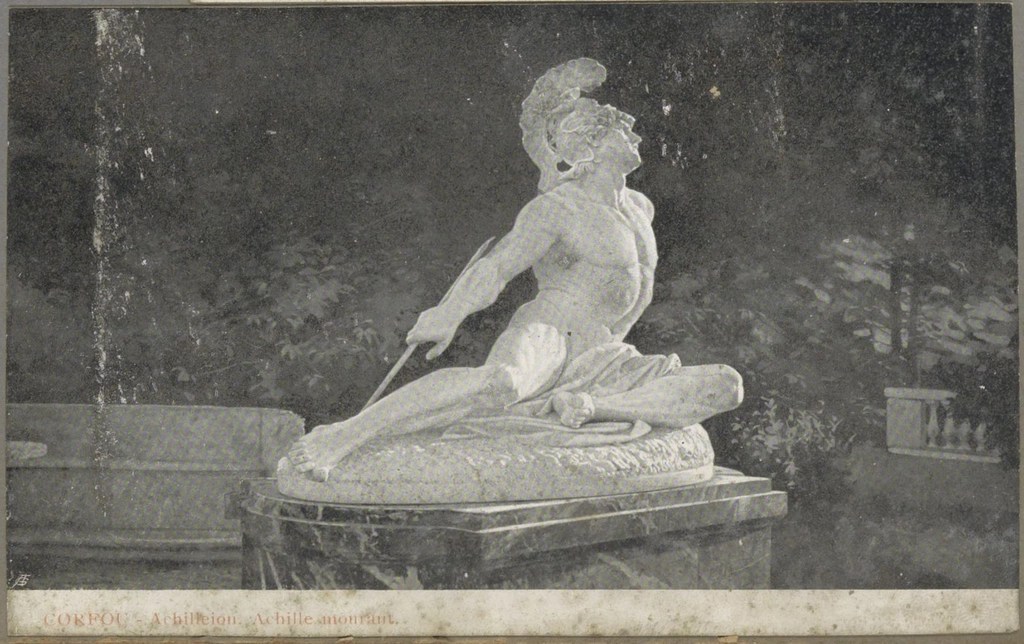
Few could not be. While it is set in this galaxy, even this planet, it is in historical terms a long, long time ago, far before Caesar, Hannibal, or Alexander. Consider that ghostly Homer spun his supernatural laced tales of a time a half millennium before his days. Yet, our saga begins a century, if not three, before Achilles’ epic feats, the Battle of Troy, and Odysseus’ journey home.
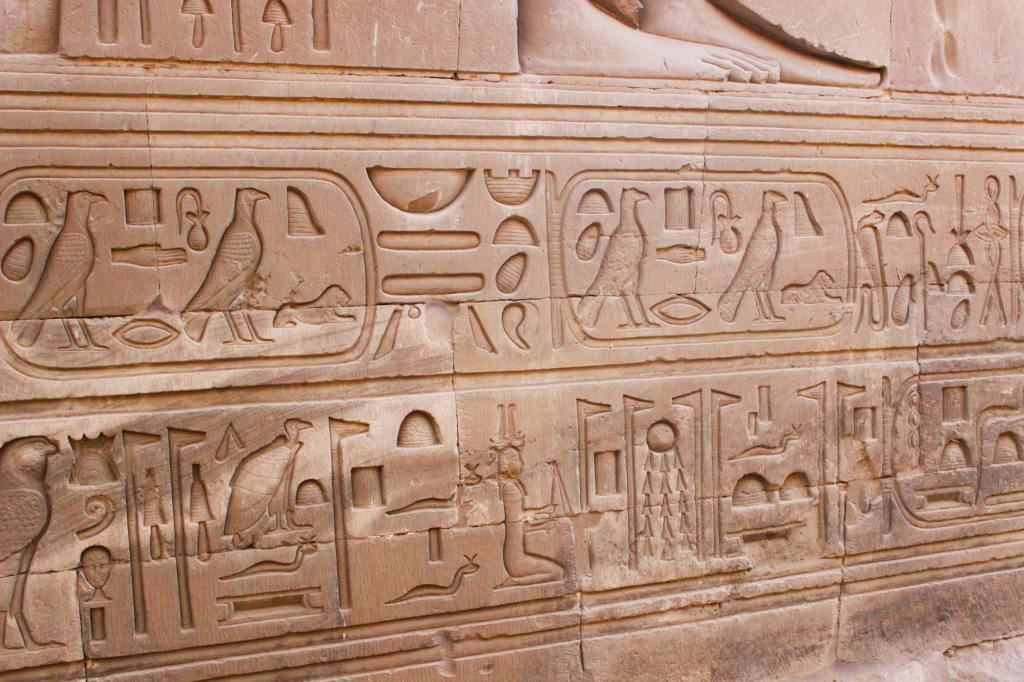
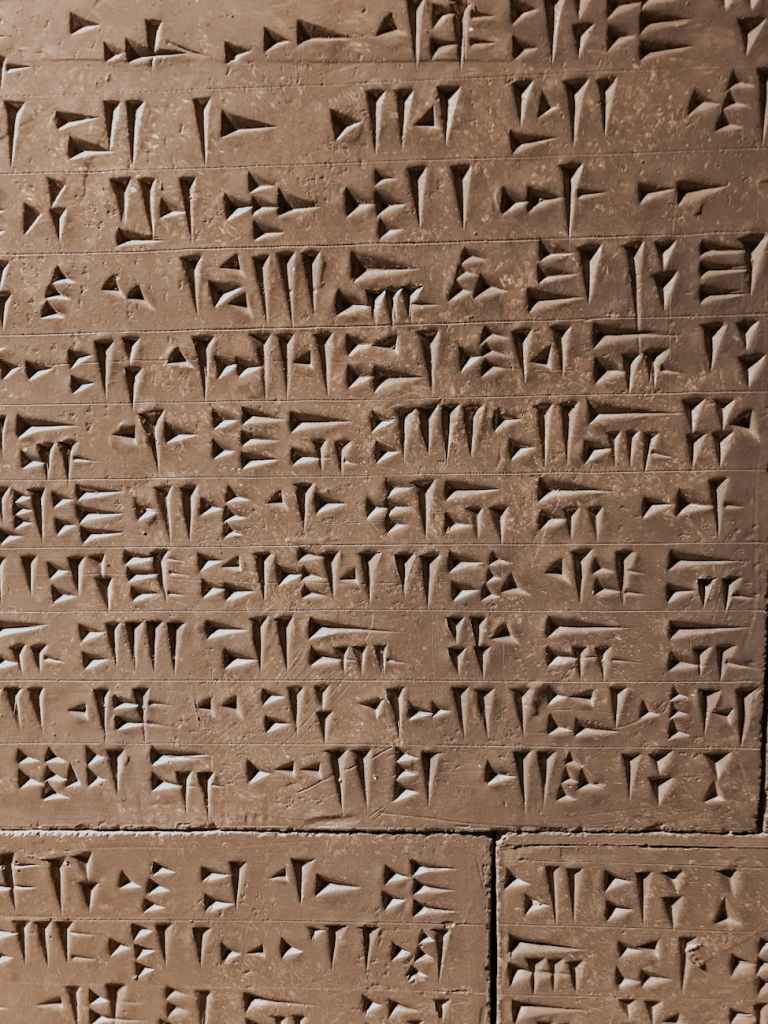
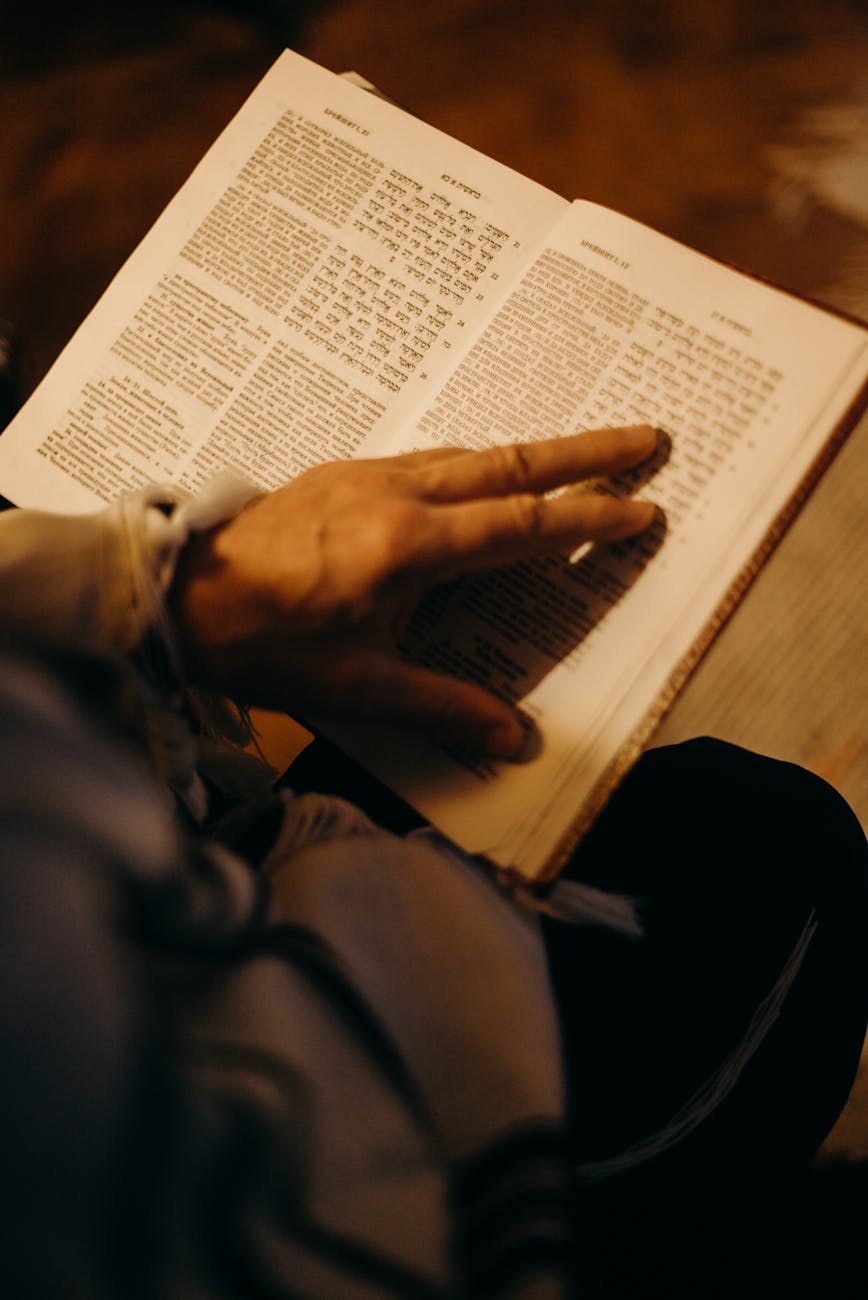
Plus it is a story about writing by a people reconned as unable to do so. By that I mean unable to write in a way that you or I would find understandable without extensive scholarly training in things like hieroglyphics or cuneiform. No, this is writing that after only a short alphabet and vocabulary lesson you can read—read as if it was a news feed on whatever device from which you usually get such.
Egyptian hieroglyphs
Photo by Luisa Castillo Osorio on Pexels.com Cuneiform
Photo by Bilge u015eeyma Ku00fctu00fckou011flu on Pexels.com
Well, I have to walk that back a bit. We would have to account for the boustrophedon track. Some ambiguities that adds to the message but without necessarily blurring its gist. This I will explain later.
Nevertheless, this story is about us actually reading the thoughts recorded by the hand of someone who lived around 3500 years ago.
But it goes beyond that. Fantastically, the thoughts related seem to detail of events and personages we know, ones believed by many the stuff of mythology—that is Moses, Joshua, and the Hebrews of the Conquest.
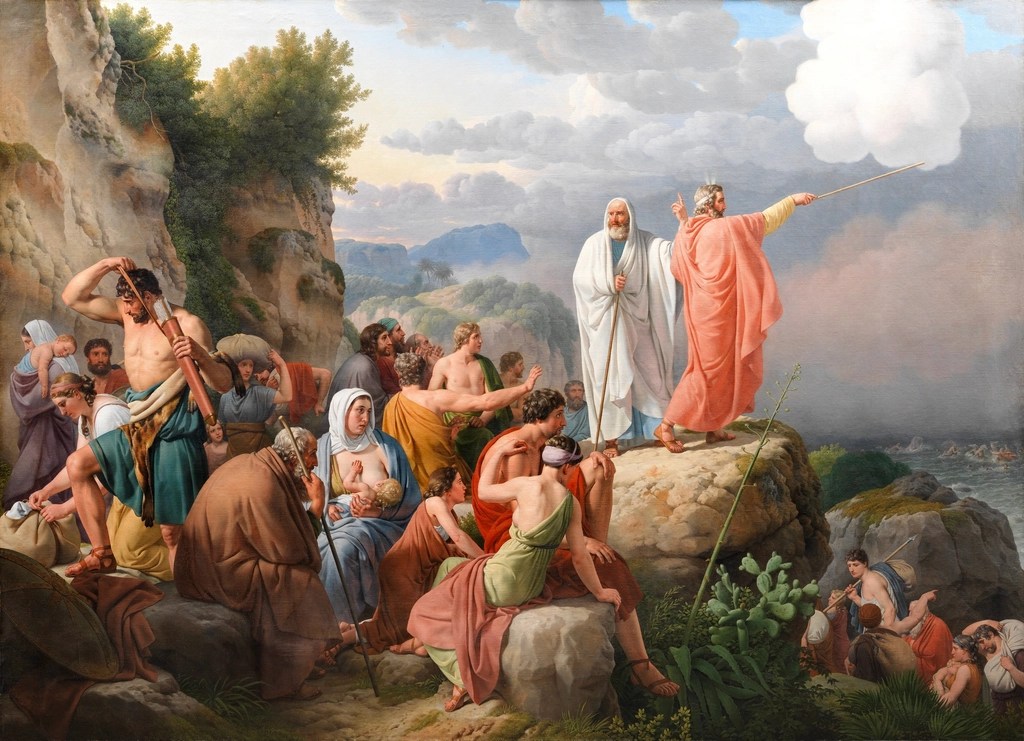
Moses closes the Red Sea
Yet, beyond its interesting nature there is another more compelling reason for my writing.
It is this: A tragedy impends. Of such I needed to alert and offer aid at averting.
A fuller forecast of this danger I discuss later.
In the next post, however, I give a nutshell version.
Why such a fuss over an artifact no bigger than a business card folded in half?
The reason is that it potentially impacts tsunami like upon man’s philosophical and spiritual bearings. Additionally, it could reorder our historical, archaeological, epigraphical, and even political understandings.
Hence there is much at stake.
A fuller explanation of this I discuss later.
Here, however, is a nutshell version:
Some claim that this so called “Curse Tablet” together with yet to be excavated clues from Mt. Ebal’s “Joshua’s Altar” may solve a thorny ancient riddle–that is, “Who wrote the Torah?”
Others say, “Not hardly!”
Many in the first camp believe that delaying further excavation could result in a catastrophic scenario–the forever loss of opportunities for discovery.
Regardless, most recognize that excavation could impede peace in a war torn region.
Authorities thus must decide:
Are the phenomenal claims about the curse tablet supported by sufficient evidence?;
Might there be other evidence at Joshua’s Altar of profound importance to mankind’s understanding of history?;
How urgently important is further excavation at Joshua’s Altar?; and
How might further excavation at Mt. Ebal be accomplished without igniting regional tensions or upsetting the international rule based order?
This memorandum explains my take on the first three of these questions.
The fourth, however, I do not here wrestle to a conclusion. How to excavate on Mt. Ebal without igniting regional and international tension, I keep mostly beyond this memorandum’s scope. Other than a few speculative hunches in my conclusion this question I largely avoid.
Why? It involves diplomatic intricacies to which I am not privy.
Nevertheless, answering the first three greatly clears the way for those with behind the scene, non-public capabilities. They then can concentrate on resolving the remaining hurdle.
The problem of the Curse Tablet, Joshua’s Altar, and Mt. Ebal represents a figurative multi-locked door. To get through, one must negotiate each.
Why should I attempt to tackle Ebal’s enigmas? The short answer is that I have appropriate experience. This includes dealing with the circumstances, resolving the issues, and guiding you in doing likewise.
For a definitive opinion on this matter one would likely at first blush consider a panel of archaeologists, epigraphers, and experts in tomography, computer science, and photography.
If the question was: “What is the ultimate truth about Mt. Ebal, Joshua’s Altar and the Curse Tablet?”, I might agree. In that case I would likely say,”Yes, the experts should receive considerable latitude.”
But that is not the current question. Instead, it is ultimately whether to excavate now or not!
To answer this question requires other elements beyond expert opinions. For one, it needs an agreed upon objective standard for decision making. Next, it needs a timely verdict.
Archaeologist, epigraphers, and similar experts are not necessarily equipped at negotiating these elements.
Consider for example an observation of Agatha Christie, the famous suspense novelist. She advised of the vehement interactions of her husband, himself a famous archaeologist, with others on archaeological issues. This she characterized as, “Blood on the carpet!”
Actual “blood on the carpet” may indeed resolve issues quickly, but likely not the non literal sense Christie intended.
Nor will it necessarily precipitate the best immediate resolutions. Instead, it may settle with the side that speaks loudest, oftenest, or worse yet today the side that best manipulates social media.
This matter is too important, too urgent for such a result.
So why me?
I possess none of the expertise of the panel listed above.
Instead, I am a combat infantry veteran of Iraq and Afghanistan. Also, I am an attorney, a mostly retired member of the Louisiana bar.
But on the questions at issue I am well qualified to make this case.
For me the necessary elements are at hand, that is, the scholarly expertise, an objective measure, and the ability to make a timely considered decision.
Further, my background informs me in the other elements of the matter—the objective measure and the timely decision.
Experience as a combat infantryman helps a bit.
First, I have keenly learned ideas about operating in a combat zone. Particularly, I have experienced scenes of civil tranquility that in a moment, often the least expected, erupt into chaotic bloodshed.
The area of Mt. Ebal can become the eye of such. Periodically, it is at least within its penumbra.
Decisions about archaeological exploration and preservation here must bear this in mind.
Additionally, another aspect of military experience is of value. Fully understanding the issues presented here requires a journey across an eon of time, one that encounters battles of ideas about truth.
For this journey one needs preparatory information.
In the U. S. Army such comes in an operation order. Anyone who has ever served knows “Sergeant Major eats sugar cookies!”—situation, mission, execution, sustainment, command and signal—the anachronism for the elements of an operation order. To equip you for this adventure the most relevant of these I detail below.
My being an attorney also adds something important. It informs of a rule of law for a situation analogous to this matter’s. It is U. S. Code of Civil Procedure Rule 56–“Summary Judgment”. This applies an authoritative objective measure, one yielding an expedited decision with more than a modicum of logic.
In this matter the public and those in authority need this type of decision making clarity.
Presently, much public confusion reigns over the issues surrounding Mt. Ebal.
About these some have already fixed notions largely derived as one might pick a favorite football team. They have decided that they prefer the red team or the blue team, the gold or the purple. Logic may not run much deeper.
About this matter the appropriate political authorities and the public who can influence them need to make up their minds quickly but after serious thought.
Why? There are immense consequences for a wrong or late response.
Delay could lead to the loss of riddle answers for another decade, another century, maybe another 3500 years. Who knows?
On the other hand, acting without deft forethought could upset the delicate political balance of a potential war zone.
The decision making process that I espouse in this memorandum offers the opportunity for an expedited, logical deliberation that this matter mandates.
In sum, stick with me for this excursion. Together we can reach our destination. We can digest the academic evidence. We can apply an objective measure. Also, on the following questions we can render expedited yet considered decisions:
Does satisfactory evidence support the fantastic claims about the Curse Tablet?; and
Should we advocate for posthaste, but careful and thorough, excavation of Mt. Ebal’s alleged Joshua’s Altar, the origin of the Curse Tablet?
Again, come along! We can do this!
But first let us make sure we have our journey essentials.
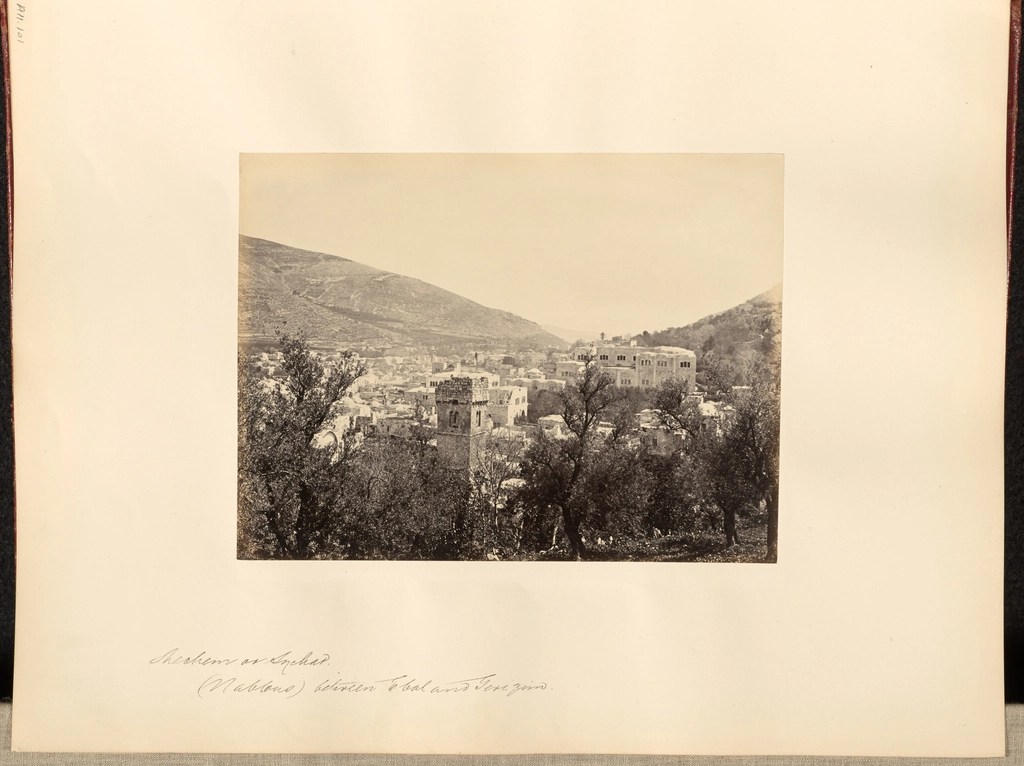
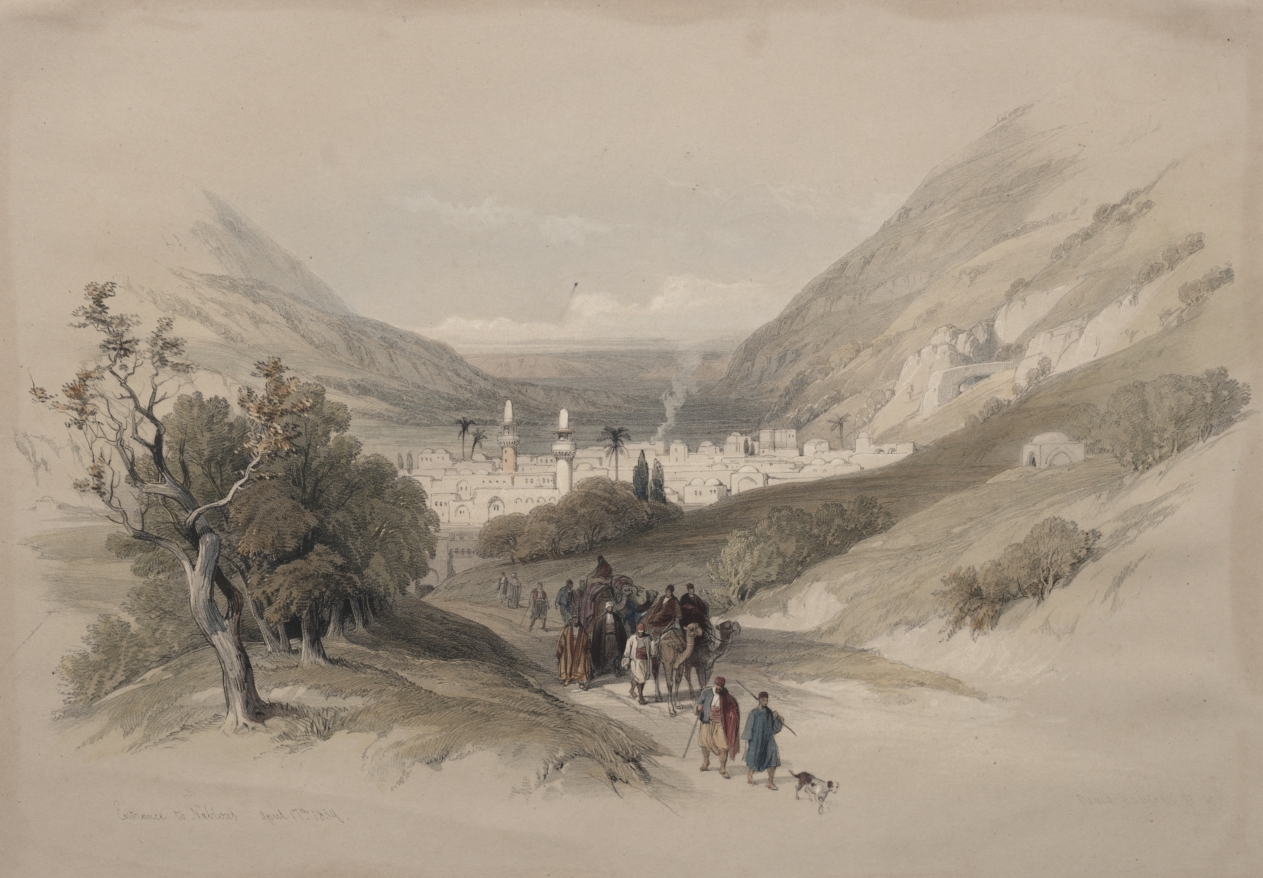
It rises in the northern third of Samaria / Judea adjacent to its slightly smaller sister–Mt. Gerazim, flanking on the south. Between the two runs a pass where one sees modern Nablus on a western neck. The location of ancient Shechem lies nearby a little eastward.
Through this passage people have accessed since antiquity the Jordan Valley on the east and the Plain of Sharon and the Mediterranean on the west.
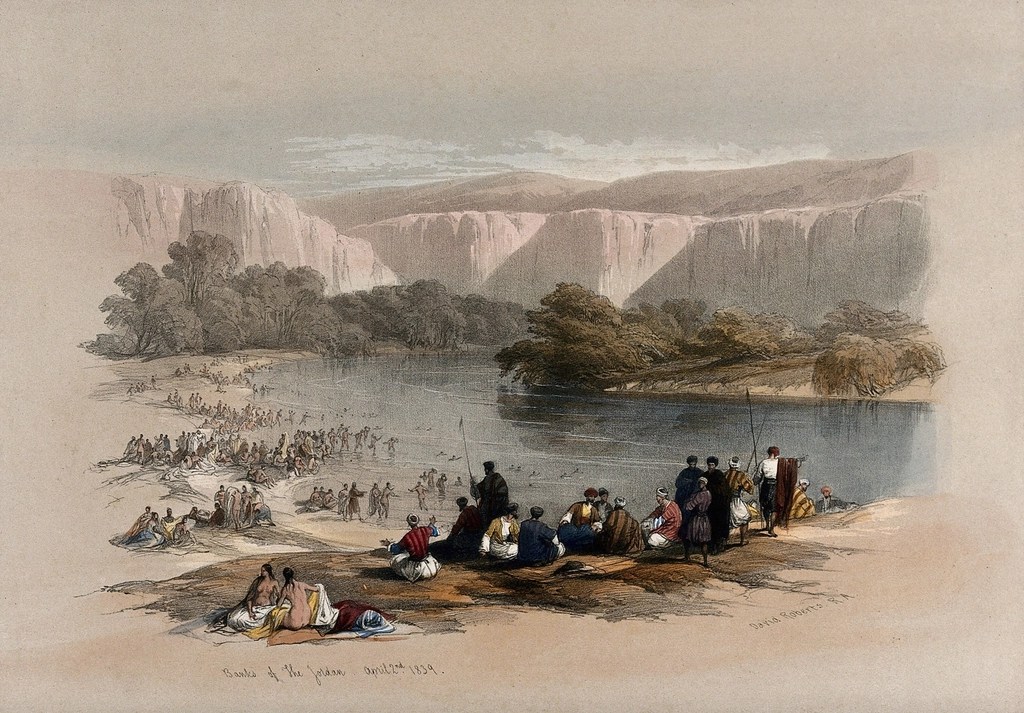
Bathers on the banks of the Jordan
A sweeping view to the North reveals the uplands of Galilee where you can glimpse the outline of Nazareth. Adjusting east one sees across the Jordan to Hermon’s whited pinnacle. Farther south the view traverses the Dead Sea to the region of Moab. Finally due south arise the heights of Jerusalem.1
A nearer view reveals a valley between the two mountains into which many springs flow. These irrigate lush vineyards, orchards, and groves yielding abundant grapes, figs and olives. But higher up near Mt. Ebal’s summit, rocky outcrops, “ubiquitous thistles and prickly shrubs” abound.2
History Preview:
Among this high setting Adam Zertal, an Israeli archaeologist, arrived in the 1980’s on a government survey mission. There he found what ultimately he came to believe was an ancient Hebrew altar.
Yet, this notion ran contrary to scholarly understanding. It was thus ultimately largely dismissed, even scoffed at.
Some forty years later an archaeological team, headed by Dr. Stripling, moved some of Zertal’s dump piles off site. To that material they applied a perfected wet sifting technique. Many small, previously missed artifacts they found as a result.
One particularly intrigued. The tiny lead object they thought a defixio, a curse tablet.
Having had significant previous experience with such, they anticipated inside an inscribed curse.
When, however, they attempted to open it, a small corner crumbled. That endeavor they ceased.
Fortunately, tomographic slice imaging enabled scans of what lay within.
Their report about the resulting photos startled much of the world. Allegedly inscribed there were proto-alphabetic letters pronouncing God’s Hebrew name–“Yahweh”, and the word “ARWR” meaning “cursed!” Furthermore, the words and provenance recalled a ceremony recorded in scripture.
After public release of the scans, eminent scholars disputed these claims.
Recently, Heritage Science published another peer reviewed essay about the tablet. In it Mark S. Haughwout , a prominent Hebrew scholar, gives his views. He also largely summarized the qualms of others scholars.
The article boldly concludes, “The only substantiated claim that Stripling et al. can make at this time is that they have found a very old, small piece of folded lead on Mt. Ebal using wet sifting.”
In other words, Haughwout determined that there is nothing to see here!
Meanwhile, the potential destruction of the Mt. Ebal archaeological site looms. This I explain later.
Mission:
This memorandum argues that government authorized excavation of Joshua’s Altar should occur posthaste. The reasons are that:
Sufficient evidence supports the fantastic claims about the Curse Tablet; and
The chance of Mt. Ebal revealing other important evidence is significant?
Execution:
In support of these positions I argue that Haughwout failed in his “refutation”, i. e., disproval, efforts.
In doing so I apply an objective measure derived from a prominent authority well accustomed at resolving issues of this nature. That is the U. S. Supreme Court.
The High Court’s Rule 56 of its U. S. Code of Civil Procedure mandates how lower courts decide motions for summary judgment.
Summary judgment, I argue, closely resemble our matter. Thus for it a standard similar to that of Rule 56 should operate appropriately.
My applying an objective measure to these facts frees you to competently make up your own mind about the issues confronted. Resultantly, you can decide yourself whether my adjudication is fair and reasonable.
Service and Support:
Embedded as lagniappe with the flowers displayed at the end of each post, I provide links to materials–written, audio, and video. These reflect the tensions associated with this topic. Adversarial material I attempt to display.
Music snippets I add for ambiance.
The last post supplies supplemental materials. This includes letters to my U. S. congressional delegation.
Command and Signal:
As co-founder of captivatingtwists.com, I authored the thirty-two posts about this matter. As my audience I welcome anyone interested in the issues presented.
Dr. Stripling and Mr. Haughwout whose peer review articles I extensively review in this memorandum are the authors of the primary sources of expert information used here.
Ultimately, this memorandum’s conclusions and recommendations are entirely my own.
The Mt. Ebal topic is one of several within Captivating Twists’ stable of subjects.
Fasten your seat belt! Prepare not only to traverse three and a half millenniums of history. Brace also to referee a joust between competing views about human reality.
The next post, the last of my introduction, teases curiosity about the journey ahead.
The controversies surrounding a recent archaeological find should matter to you. This brief explains why.
When prominent experts allege that a series of photographs challenge long established precepts of world history while others claim, “There is nothing to see here!”, you might think, “Show me the photos! Decide myself, I will!”1
Photos of a defixio, a curse tablet found in Israel in 2019, present such a quandary. Because the tablet cannot be opened without crumbling, an archaeologist employed tomographic scanning to peer inside. Reportedly, this revealed proto-alphabetic script, a claim that given the archaeological context potentially challenges long held scholarly understandings of world history.
When, however, the archaeologist publicly released photos of the scans, some experts denied that they showed anything of significance.
My goal here is two fold. I want to assist you in reaching a well informed understanding of the tablet. Further, I hope to encourage you to act on what you learn.
But beware! Conversing intelligently about the photos requires more than a mere viewing. To most, other than a few specialized experts, they appear utterly mysterious.2
Yet, lay persons with some assistance can make well considered observations regarding them.
To do so they need three things. First, they need the history. Then they need an opportunity for efficient study. Lastly, and most importantly, they need enthusiasm. That is, enthusiasm for the history and for probing the evidence.
Below, I relate the history.
Furthermore, I guide an efficient online study of the photos.
But what about the enthusiasm?
Possibly viewing a 30 second video might spark something. It shows, of all things, a technological process being applied to a piece of metal.
Wow! How thought provoking and intriguing can that be?
Glance momentarily at the video’s millimeter ticker in the top left corner. When it gets to .20 mm, focus particularly on the object’s top right.
Alternatively, watch the red bar on the right graph. When it approaches the major breach, focus on your screen’s top right.
It helps also to move your cursor over the top right and click. This expands the image.
Do you see anything?
Maybe you perceive only happenstance cracks, dents and scratches on a very old piece of lead.
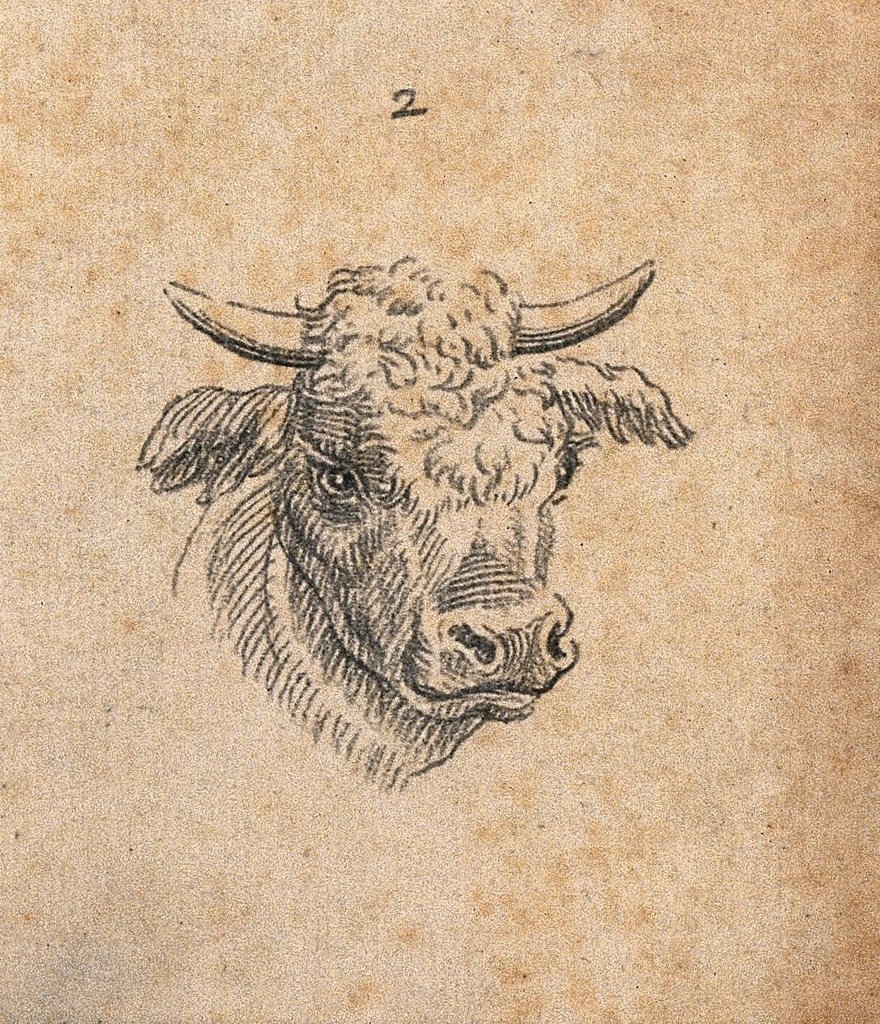
But, what about a stick man, a mace, some crossed hockey sticks? Maybe you detect some squiggly lines, a bent arm with an open hand, and a couple of ox skulls?
Ox head Crossed hockey sticks
Photo by Tony Schnagl on Pexels.com A bent arm with open hand
Photo by Daria Liudnaya on Pexels.com A role play Viking warrior wielding a mace
A canon of human history may hang upon which of these assessments is correct.
Regardless of what you see, this viewing likely piques some wonder. Possibly questions arise like:
What is the story here?
How could that story impact history?
Why should I or others care?
This memorandum seeks to prepare you for these and other issues.
Hopefully at its end you can intelligently scrutinize whether the Mt. Ebal Curse Tablet harbors proto-alphabetic script or even ancient Hebrew words . Plus you can ponder whether it challenges scholarly world history.
In sum, then you can knowingly engage with me whether:
This is a story about two archaeology discoveries. Both have potential dizzying impact on our understanding of biblical and world history.
Closely identified, having come from the same location, they are well separated in time of discovery. The first became known about 40 years ago. Identification of the latter occurred within the last six.1
Yet, they poise a piercing assault on a long understood, entrenched, scholarly paradigm—one considered by many virtually unassailable.
What is that? It is that Moses did not write, and, in fact, could not have written, the first five books of the Bible, that is the Torah or Pentateuch.2 This the paradigm holds despite other Old Testament sources, as well as Jesus of the New, having affirmed or implied Mosaic authorship.
If not Moses who lived allegedly around the Twelfth to Fifteenth Century B. C., then who? In short, the theory holds that a collection of authors mostly from the Ninth to the Third Century B. C. wrote the Torah’s accounts.3 These late date writers aimed at manufacturing for the Hebrew people a shared identity—one fortifying moral cohesion and reverence for mythological heroes.4
This idea permeates more than the ivory towers of elite universities. It holds sway over heartlands worldwide. Since the late 19th century, the idea has schooled generations of priests and preachers as well as waves of college students enrolled in scholastic biblical studies.5
This paradigm against Mosaic authorship has a name. It is the documentary hypothesis.6
Now, let us examine these two discoveries challenging it.
Greg A. King, The Documentary Hypothesis, Journal of the Adventist Theological Society, pp. 22-30, p. 25, paragraph 7, December, 2001; and Special Update: The Mount Ebal Curse Tablet (Ep1 of 3), Youtube: Patterns of Evidence, youtube.com/watch?v=YX3TH_nfgLo, Episode One at (29:45), May 21, 2024. ↩︎
Associates for Biblical Research, Cursed! The Mount Ebal Curse Tablet (Part Three, Digging for Truth Episode 200), YouTube, (06:45), May 1, 2023; Breaking News “Mt Ebal Curse Tablet Peer Review Complete”, Appian Media, In Roads, youtube.com/watch?v=_15tYO4hqJS, (22:30 and 24:40), May 12, 2023; and Greg A. King, The Documentary Hypothesis, Journal of the Adventist Theological Society, 12/ 2001, pp. 22-30, p. 22, paragraph 2. ↩︎
Id.; and Sean McDowell, Oldest Hebrew Writing? Mt. Ebal Curse Tablet (Revisited) m.youtube.com>watch, (20:00 & 33:49), 11 May 2023. ↩︎
The area drips with serious biblical relevance including for example—the site of the Abrahamic covenant, 2 Jacob’s well, Joseph’s burial site, Jesus’ interactions with the Woman at the well, and an incident most relevant to out story.
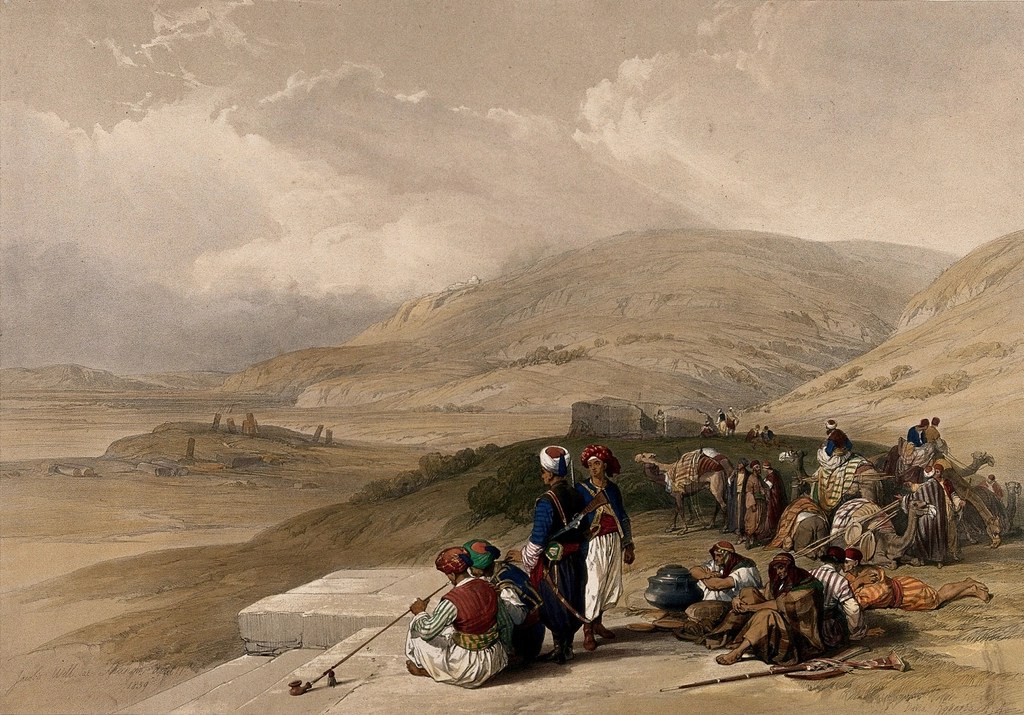
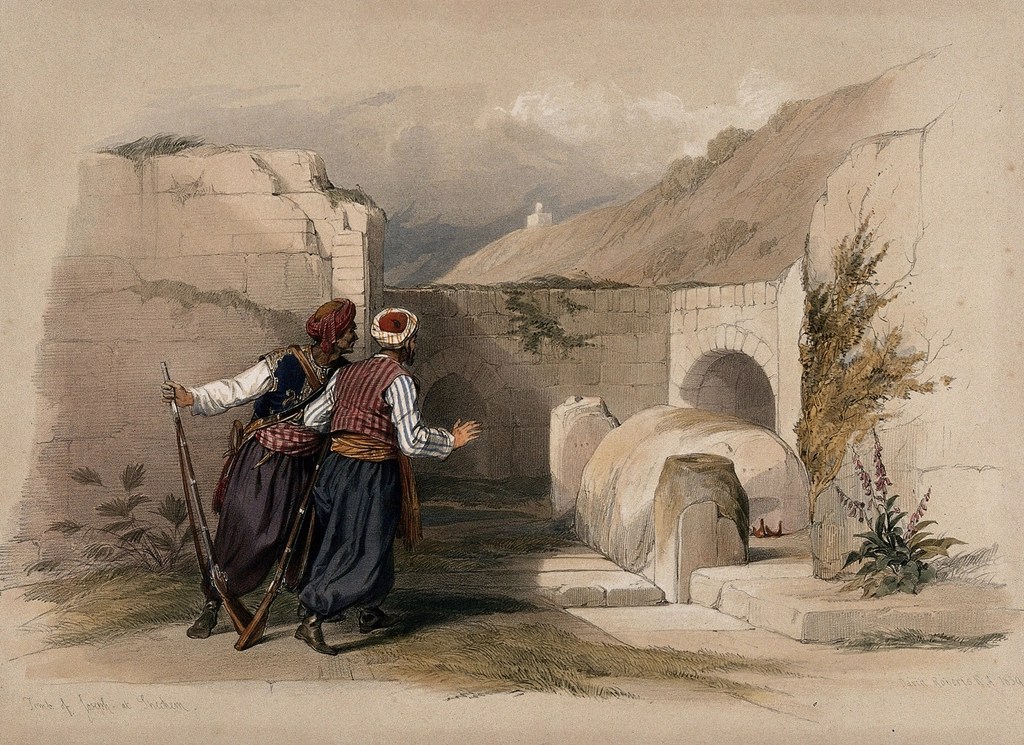
Travelers resting at Jacob’s Well
Early 19th century painting by David Roberts Visitors at Joseph’s tomb
Of the latter Deuteronomy 11:29 and 27:12 to 28:68 tell. These verses detail Moses’ directions for a rather odd ceremony–the Ceremony of Curses and Blessings on Mounts Gerizim and Ebal. 3
That event unfolds something like this:
Because Moses could not enter the Promise Land, he directs Joshua, his successor as leader of the people of Israel, in effect: “Once you have sufficiently conquered a foothold in the land, go to Mt. Gerizim and Mt. Ebal. Set up stones brought from Jericho. Plaster them and write there on the words of the law. Position half of the tribes on one mountain and half on the other. Announce blessing from Gerizim and curses from Ebal. On Ebal build an altar of non-hewn stones. To the God of Israel sacrifice the blood of innocent animals to cover the sins of the guilty.”
Joshua’s accomplishing these directives one finds in Joshua 24:1, 25-26, and 32. 4
Of this relevance, however, Zertal had little inkling. Descended from East European immigrants who had lived under Soviet domination, he had grown up on a kibbutz. To him and many of his kin biblical connections had almost no resonance. Spiritually he was agnostic. Despite being an esteemed scholar and warrior—he had been seriously wounded in combat and walked with a cane much of his later life—about scripture he was almost clueless. His academic training had only cemented his conviction that the Bible was mostly mythology.5
That was about to change.
Exploring the backside of the mountain he observed a peculiar mound. He did a quick survey. From this he concluded that the place deserved serious investigation.
Subsequently, his team removed a substantial covering of stones revealing a baffling structure. What is this? Nothing about it resembled anything of Zertal’s experience.
After a period of head scratching wonder, an under-associate informed Zertal of a possible explanation.
The gist of this was: “This mountain people of a biblical slant scoured for decades looking for a particular structure. For it they focused on the side of Mt. Ebal facing its twin mountain, Mt. Gerizim. Convinced that it must be there, they ignored the back side where this site lays on a lip just over the summit.”
“Could this be what had confounded many?”, the understudy postulated. “Could this be Joshua’s Altar, the one that Moses in Deuteronomy 27 and 28 had commanded him to build!?”6
Of this, over time Zertal, the agnostic, eventually became convinced.7
At this point I stop the Harrison Ford type narrative and suffice for brevity with a simple listing of the things that eventually supported his conviction. They are:
The location of the site offered an largely unfettered view of the eastern horizon, something essential to the tabernacle’s and later the Temple orientations. Such was not readily available from the side of Mt. Ebal facing Mt. Gerazim. Both Exodus 27:13 and 2 Chronicles 5: 11-12 imply that the entrance of the Tabernacle and later the Temple faced eastward.
A huge enclosure made of stones surrounds the altar site. Bizarrely, it resembles a footprint, not more than three feet in height but over three football fields in length.8 Within it was another “footprint” about a 100 meters in length. (About six such structures one finds leading up the Jordan Valley culminating at Mt. Ebal.9 Some theorize that the Hebrews of the conquest constructed these. Supposedly, they were to symbolize God’s Mosaic promise to give them all the land within the parameters of the Promised Land on which their feet trod.)10
A long ramp rose to an altar site.11 Stairs Moses’ instructions forbid.
The altar site consisted only of non hewed stones, that is, field stones untouched by any iron tool. This Moses had directed.12
Excavations revealed two potential altars, one larger rectangular one encompassing a smaller circular one beneath at its center, both containing bones of almost exclusively kosher animals. (A small percentage of bones belonged to creatures that may have climbed among the rocks and died such as turtles or snakes.)13
Pottery fragments there dated only to Iron Age One and Bronze Age Two, both consistent with competing theories for the date of the Exodus and the Conquest.14
Another scholar on seeing a photo of the Ebal site noted to Zertal in effect, “That uncannily corresponds to an ancient drawing depicting Jerusalem’s second temple altar.”
These verisimilitudes convinced Zertal.
On publicly announcing his findings, a tremor rumbled through the archaeological and theological worlds.
Yet, as we will see in the next post, it was only a tremor, not the epic seismic event evidently necessary to shake the illiterate or mythological Moses parordine.15
Sean McDowell, Oldest Hebrew Writing? Mt. Ebal Curse Tablet (Revisited) m.youtube.com>watch, (5: 26-44), 11 May 2023. And Associates for Biblical Research, Cursed! The Mount Ebal Curse Tablet (Part One, Digging for Truth Episode 200), YouTube, (04:29; 05:21), May 1, 2023. ↩︎
Steve Law, patternsofevidence.com, Ancient Hebrew Writing on Tablet Discovered at Joshua’s Altar, paragraph 5, February 4, 2022 And Associates for Biblical Research, Cursed! The Mount Ebal Curse Tablet (Part One, Digging for Truth Episode 200), YouTube, (10:29), May 1, 2023. ↩︎
Associates for Biblical Research, Cursed! The Mount Ebal Curse Tablet (Part One, Digging for Truth Episode 200), YouTube, (12:08), May 1, 2023. And Adam Eliyahu Berkowitz, Skeptics of Ebal Curse Tablet Accuse Christian Researchers of “Seeing the Face of Jesus in a Grilled Cheese Sandwich”, israel365news.com, Archeology, paragraph 3, December 6, 2023. ↩︎
Steve Law, patternsofevidence.com, Ancient Hebrew Writing on Tablet Discovered at Joshua’s Altar, paragraph 23, February 4, 2022. ↩︎
Associates for Biblical Research, “ABR Researchers Discover the Oldest Known Proto-Hebrew Inscription Ever Found”, biblicarchaeology.org/current-events-list/, Youtube, (15:32), March 24, 2022. and Associates for Biblical Research, Cursed! The Mount Ebal Curse Tablet (Part Four, Digging for Truth Episode 200), YouTube, (11:25 and 12:48), May 1, 2023. ↩︎
Steve Law, patternsofevidence.com, Ancient Hebrew Writing on Tablet Discovered at Joshua’s Altar, paragraph 23, February 4, 2022. And (Deuteronomy 11:23-24); And (Joshua 1:3) ↩︎
Associates for Biblical Research, “ABR Researchers Discover the Oldest Known Proto-Hebrew Inscription Ever Found”, biblicarchaeology.org/current-events-list/, Youtube, (15:02), March 24, 2022. ↩︎


































 captivatingtwists.com
